- Monkey testing uncovers failures that scripted tests can’t, especially edge-case crashes and unpredictable behaviors.
- Different monkeys play different roles, dumb for quick chaos, smart for structured randomness, brilliant for business-flow stress, and chaos for infrastructure resilience.
- Monkey testing reduces incidents, accelerates releases, and saves cost, especially in complex, multi-device environments.
- A balanced QA strategy needs both monkey and gorilla testing to validate broad stability and deep modular robustness.
- AI is transforming monkey testing through smarter event generation, crash clustering, telemetry-driven chaos, and LLM-based risk predictions.
Let’s start with a hard truth: your app users are the ultimate, unforgiving testers. But they won’t be filing out polite bug reports. They’ll be deleting apps, abandoning carts, and shredding your brand’s reputation on social media. The question is, are you still relying solely on scripted, predictable tests while your software faces a world of pure digital chaos? This is where monkey testing in software testing steps in!

By 2034, the global software testing market is projected to soar past $112.5 billion, at a staggering CAGR of 7.2%, driven by the desperate need to cope with unprecedented system complexity. In this scenario, the evolution of monkey testing from a niche technique to a boardroom imperative becomes imminent. But what is monkey software testing, why does it matter, and how to implement it in your QA plan in 2026? Let’s find out!
What Is Monkey Testing, and How Does It Work?
In a nutshell, monkey software testing is the art of unleashing automated, random, and often nonsensical inputs on your application. Think of a hostile primate (monkey) banging away at a keyboard, clicking furiously. The “monkey” recognizes no rules, no user stories, and no happy paths. Its whole reason for being is to break what you’ve built, revealing the hidden cracks that structured tests inevitably miss.
Monkey testing in software testing sends random actions to the application and notices how it reacts. The testing focuses on behaviors that are difficult to predict, instead of planned steps.
Here’s a quick overview of how monkey testing works:
- Random Inputs: The tester enters anything randomly, strikes random keys, or types any information without adhering to any test case. The tester should behave like a primate with no rules.
- System Observation: The tester provides follow-up on how the app reacts to such random events by monitoring crashes, freezes, and strange errors that happen during chaotic interactions.
- Test Objective: The objective of monkey testing is to simulate real user mistakes. It uncovers problems that might be left out during structured testing in the early development phase.
What Are the Different Types of Monkey Testing?
Monkey testing is not a one-size-fits-all variety. Better to think of it as a strategic arsenal where different varieties of “monkeys” serve different purposes in your digital quality engineering strategy. Understanding the types of monkey testing will help you choose the right kind of chaos toward finding the most relevant defects.
Various types of monkey software testing include:

- Dumb Monkey: Sends raw random UI events in early-stage testing and quick smoke checks. This catches immediate UI crashes and app freezes.
- Smart Monkey: It tests random events constrained by UI models in mature apps with complex flows, identifying logical state errors and data corruption scenarios.
- Brilliant Monkey: Runs purchase flows or session rules in finance, commerce, or critical workflows. It finds edge-case order states and transactional inconsistencies.
- Chaos Monkey: Introduces latency and partial failure in microservices and cloud deployments; spotting detects fallback errors and misrouted transactions.
Why Does Monkey Testing in Software Testing Matter?
Because your development team’s scripted tests are designed to confirm the system works as intended. Monkey testing software is designed to discover how it fails under duress. It’s the difference between checking the locks on your front door and hiring a stress tester to try every window, air vent, and weak hinge. The latter reveals true security posture.
Here are some convincing reasons to invest in chaos monkey testing:
- Fewer Incidents: Monkey testing detects errors that might otherwise slip to production.
- Cost Saving: Bug fixes pre-deployment cost 4-8x less than post-production hot fixes.
- Greater User Retention: Avoiding a single app crash can save you thousands.
- Faster Release: Combine monkey testing with regression testing for release readiness.
How Monkey, Gorilla, Stress, Fuzz, Ad-hoc, Exploratory, and Endurance Testing Differ?
A modern QA strategy isn’t built on one kind of testing, but it is a blend of structured checks, chaos engineering, deep functional drilling, and behavior-driven discovery. Here’s a quick, executive-friendly breakdown of how each testing style fits into your QA strategy:
| Testing Type | What It Does | When to Use It | What It Reveals |
|---|---|---|---|
| Monkey Testing | Sends random inputs across the app | Early stability checks, CI nightly runs | Crashes, freezes, memory leaks |
| Gorilla Testing | Repeatedly tests a single feature with intensity | Before releasing critical modules | Module defects workflow flaws |
| Stress Testing | Pushes the system beyond its limits | High-traffic events, seasonal peaks | Load failures, capacity thresholds |
| Fuzz Testing | Injects malformed or corrupted inputs | Security testing, API testing | Parsing failures, input validation bugs |
| Ad-hoc Testing | Informal testing based on intuition | Quick checks, runs before releases | Defects from non-scripted interactions. |
| Exploratory Testing | Simultaneous learning, executing tests | When requirements are unclear/evolving | Logic gaps, usability flaws, workflow issues |
| Endurance Testing | Tests system behavior over extended time | Transaction-heavy apps | Memory leaks, stability issues |
5 Biggest AI Trends in Monkey Software Testing for 2026
With the evolution of software testing and quality assurance, monkey testing integrates several new technologies, including AI-powered testing. Following are the current AI trends that rule the game in chaos monkey testing for the year 2026:
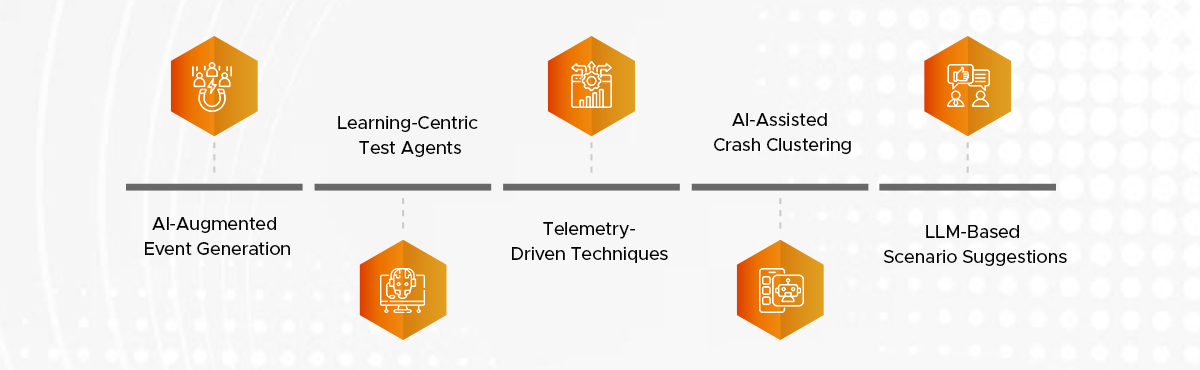
- AI-Augmented Event Generation: AI/ML models detect which actions are most likely to fail in the software, helping testers focus on weak spots instead of sending random events all over the place.
- Learning-Centric Test Agents: The reinforcement learning agent revolutionizes monkey software testing by learning the paths that cause problems or delays. That assists QA teams in finding deep crashes quicker than in standard random testing.
- Telemetry-Driven Techniques: AI now relies on production telemetry to learn how real users behave. Once done, the monkey testing software runs random tests based on real usage patterns, therefore driving testing to be more data-oriented.
- AI-Assisted Crash Clustering: AI clusters app crashes and removes similar error patterns. It also reduces manual triage work needed for accelerating bug finding.
- LLM-Based Scenario Suggestions: LLMs are great when it comes to reviewing documentation, user stories, and issue history. They help in finding the areas likely to be at high risk.
Why CTOs and CIOs Are Prioritizing Monkey Testing for 2026 Releases?
In 2026, software doesn’t fail because of obvious bugs. It fails because real-world conditions behave nothing like your test cases. Enterprises dealing with multi-layered architectures, global user bases, and AI-driven interfaces are discovering that traditional test strategies simply can’t anticipate the randomness of real production usage.
Here’s why monkey software testing is no longer optional but a boardroom-level necessity.
- Complex Multi-Device Ecosystems: Your users switch from mobile, tablet, wearable, and embedded devices without a second thought. So, only monkey testing reveals cross-device interaction failures; no scripted test ever anticipates.
- Microservices and Distributed Architectures: Modern systems rarely fail at the UI layer—they break in the spaces between services. Monkey testing exposes chain-reaction failures, stale states, and orchestration errors.
- Unpredictable Real-World Traffic Patterns: Traffic surges don’t follow neat load curves. Real users tap, swipe, refresh, and rage-click in chaotic, accelerated bursts. Monkey testing simulates this organic chaos, making sure your app doesn’t collapse under sudden spikes.
- AI-Driven UI Flows & Personalization: AI-driven UIs shift layouts, reorder options, personalize content, and show dynamic elements. Scripted tests miss what AI changes. Here, monkey testing ensures your app stays stable no matter what your AI decides to do next.
- High-Scale Production Applications: If your business handles millions of customers, global transactions, or financial operations, then edge-case crashes are million-dollar liabilities. Luckily, monkey testing is the fastest way to stress reality into your system, not assumptions.
- Regulatory or Financial Risk: Industries like banking, healthcare, insurance, eCommerce, and aviation can’t afford “unexpected crashes.” Monkey testing exposes failures that could result in compliance breaches, lost transactions, and corrupted records.
Final Thoughts on Monkey Testing
Monkey software testing looks chaotic by design, but with the right strategy, it becomes one of the most efficient ways to surface real-world problems before your customers do. QASmartz combines targeted monkey modalities, robust telemetry, CI/CD automation, and artificial intelligence so chaos becomes predictable. So, stop hoping your application is resilient. Start knowing it is. Unleash the monkey, command the chaos, and build software that endures.
Experience QASmartz –
Free 40-Hour QA Trial
- Identify hidden bugs before they hit production
- Experience accelerated test cycles with automation
- Validate performance, security, and compliance across your apps
- Get a tailored test strategy for your business needs

Ankita Bhambi
Ankita Bhambi is a Project Manager at QASmartz with expertise in AI-powered Delivery Excellence, automation engineering, and scalable test strategy. With over 14 years of engineering experience, she leads delivery quality across complex, large-scale ecosystems and brings strong domain experience in Retail (Supply Chain), SaaS, FSI, Media (TV Distribution), Telecom, and Healthcare, leveraging deep automation and performance engineering skills to drive speed, reliability, and high-impact outcomes.
Frequently Asked Questions
- Select a tool (open-source or commercial)
- Define the scope (entire app or a module)
- Configure the level of "intelligence" (dumb, smart, brilliant)
- Let it run automatically, often overnight
- Triage the crash reports it generates to fix underlying weaknesses